Pain in Belly Button When Peeing: Clinical Causes and Anatomy
Experiencing a sharp, pulling, or stinging pain in your belly button right as you begin to urinate or immediately after finishing is an incredibly specific and alarming clinical symptom. Unlike general stomach aches or digestive cramping, pain that is strictly synchronized with the physical act of emptying your bladder points directly to a urological issue or a distinct anatomical connection hidden beneath your abdominal wall.
Many patients describe this sensation as a tight string being forcefully pulled from the inside of the navel straight down into the pelvic floor. To understand why this happens, you must look beyond the exterior scar tissue of the belly button and examine the complex network of ligaments and nerve pathways that physically tether your lower urinary tract to your anterior abdominal muscles. By identifying the specific trigger, whether it is a severe bacterial infection in the bladder lining or a microscopic congenital remnant stretching during urination, you can accurately diagnose the underlying cause and seek the appropriate urological treatment.
The Anatomical Link: The Median Umbilical Ligament
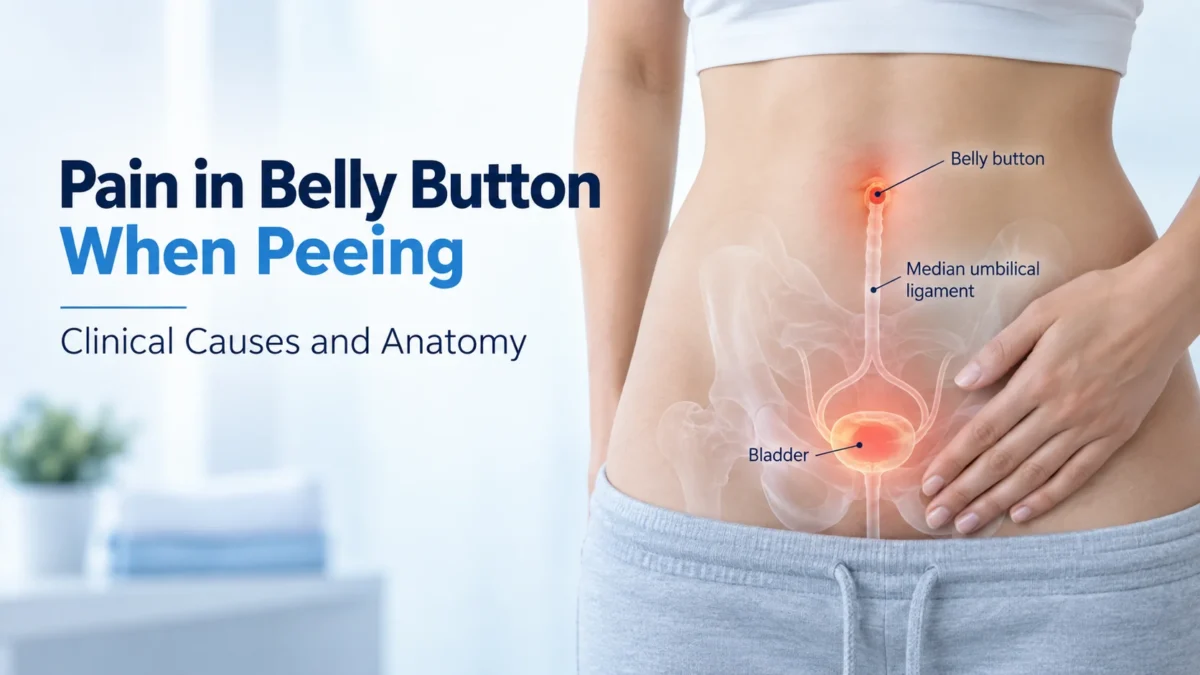
The most direct and physiological reason you feel a sharp pulling sensation in your belly button while peeing involves a highly specific internal structure called the median umbilical ligament.
During fetal development in the womb, your developing urinary bladder was directly connected to your belly button via a tiny tube called the urachus. This tube allowed fetal urine to drain safely into the umbilical cord. Before you were born, this biological tube naturally collapsed, solidified, and transformed into a permanent, dense fibrous cord. In adult anatomy, this cord is known as the median umbilical ligament. It runs vertically from the apex, or the very top dome, of your bladder, straight up the inside of your abdominal wall, and anchors itself permanently to the back of your belly button.
When you urinate, your bladder rapidly decompresses, deflates, and forcefully contracts its muscles to push the fluid out through the urethra. Because the top of the bladder is physically tethered to the belly button by this ligament, a sudden, violent, or highly inflamed bladder contraction can physically yank on the median umbilical ligament. This internal mechanical pulling transfers directly to the back of the navel, resulting in a sudden, sharp, pulling pain that immediately stops once the bladder relaxes.
Urinary Tract Infections and Referred Pain
While the physical pulling of the ligament explains the sensation, the underlying cause of the pain is frequently an active bacterial infection. A severe lower Urinary Tract Infection, or UTI, is the leading clinical cause of dysuria, which is the medical term for painful urination.
When aggressive bacteria, such as Escherichia coli, enter the urethra and rapidly multiply inside the bladder, they cause a condition known as cystitis. The mucosal lining of the bladder becomes highly inflamed, severely swollen, and raw. When an infected, inflamed bladder contracts to expel urine, the muscle spasms are incredibly aggressive and erratic. This violent spasming not only causes a deep, burning ache in the lower pelvis but also sends shockwaves of referred pain radiating straight up the median umbilical ligament, culminating in a sharp, stinging sensation directly behind the belly button.
If a UTI is causing your umbilical pain, you will almost always experience secondary urological symptoms, including a relentless urge to urinate even when the bladder is empty, cloudy or blood tinged urine, and a strong, foul odor emanating from the urine.
Interstitial Cystitis and Bladder Pain Syndrome
If you frequently experience severe belly button pain during urination but your urine tests consistently show zero signs of a bacterial infection, you may be suffering from a chronic urological condition called Interstitial Cystitis, also known as Bladder Pain Syndrome.
Unlike a standard UTI caused by an acute bacterial invasion, Interstitial Cystitis is a chronic, non-infectious inflammatory disease of the bladder lining. The exact cause is neurologically complex, but it results in the bladder wall becoming permanently irritated, hyper-sensitive, and completely stripped of its protective mucosal layer. As the bladder fills with acidic urine, the raw tissue burns continuously.
When a patient with Interstitial Cystitis urinates, the mechanical contraction of the damaged bladder wall triggers extreme, agonizing nerve pain. Because the pelvic nerves are highly intertwined with the anterior abdominal nerves, this profound bladder pain frequently radiates upward, presenting as a debilitating, sharp ache centered precisely within the umbilicus.
Urachal Remnant Disorders and Internal Cysts
In rare clinical cases, the fetal urachus tube does not completely solidify into a solid ligament before birth. Instead, a small microscopic section of the tube remains structurally open, forming a hidden pocket between the bladder and the belly button, known clinically as an urachal cyst.
For decades, this cyst can remain completely asymptomatic and dormant. However, if bacteria migrate from the bladder up into this hidden pocket, the urachal remnant can become severely infected. An infected urachal cyst swells with localized purulent fluid and becomes incredibly tender. Because the cyst is trapped directly on the tether line between the bladder and the navel, the act of peeing physically stretches the infected cyst. This stretching triggers a highly localized, agonizing stabbing pain located just an inch or two directly below the belly button. In advanced stages, an infected urachal cyst may even rupture, leaking foul smelling fluid directly out of the front of the belly button.
Pelvic Floor Dysfunction and Muscle Spasms
The physical act of urinating requires complex, highly coordinated communication between the bladder muscles and the surrounding pelvic floor muscles. If these muscles are chronically tense, you can develop Pelvic Floor Dysfunction.
When you sit down to pee, your pelvic floor muscles are supposed to relax entirely to allow the bladder to empty smoothly. In patients with pelvic floor dysfunction, these muscles instead go into a state of severe, involuntary spasms. These violent muscular contractions create massive intra-abdominal pressure that violently tugs on the surrounding fascial tissue. Because the abdominal fascia is physically woven around the umbilical ring, this intense pelvic cramping sends sharp, shooting nerve signals straight up into the belly button, mimicking the pain of a direct organ infection.
When Should You Seek Immediate Medical Evaluation?
Experiencing temporary umbilical pain during urination due to a minor, passing bladder spasm is generally not a cause for immediate panic. However, there are critical clinical warning signs that demand urgent urological evaluation to prevent severe kidney damage or systemic infection.
You must proceed to an urgent care clinic or emergency room immediately if the pain in your belly button while peeing is accompanied by visible, bright red blood in your urine, medically known as gross hematuria. Seek urgent medical attention if you suddenly develop a high fever, uncontrollable shivering, extreme nausea, or a deep, agonizing pain radiating into your mid-back or flank. These are primary clinical indicators that a simple lower urinary tract infection has aggressively bypassed the bladder and is actively attacking the kidneys, which is a life-threatening medical emergency known as pyelonephritis.
Frequently Asked Questions
Your belly button hurts when you pee because the top of your urinary bladder is physically attached to the back of your navel by a fibrous cord called the median umbilical ligament. When the bladder contracts during urination, it physically pulls on this ligament, causing a sharp sensation behind the belly button.
Is it normal to feel a sharp pulling string when urinating?
It is a common anatomical sensation, but it is not clinically normal. Feeling a sharp, pulling string sensation during urination usually indicates that the bladder is severely inflamed, spasming erratically due to a Urinary Tract Infection, or pulling on a congenital urachal remnant hidden behind the abdominal wall.
Yes, a severe Urinary Tract Infection can absolutely cause belly button pain. The intense inflammation of the bladder lining, known as cystitis, causes violent muscle spasms when you urinate. This deep pelvic pain easily radiates up the connective ligaments, presenting as a sharp, stinging pain directly inside the umbilicus.
The pain occurring immediately after you finish peeing is often caused by the bladder fully collapsing and squeezing completely shut to empty the final drops of urine. This terminal contraction places maximum tension on the median umbilical ligament, resulting in a brief, sharp tug right below the navel.
What is an urachal cyst and does it cause pain when peeing?
An urachal cyst is a rare, fluid filled pocket left over from fetal development, located on the ligament connecting the bladder to the belly button. If this cyst becomes infected, the physical act of the bladder contracting during urination stretches the inflamed cyst, causing agonizing, highly localized pain.
Yes, Interstitial Cystitis, or Bladder Pain Syndrome, causes chronic, severe irritation of the bladder wall without an active infection. The extreme nerve pain generated by this condition frequently radiates throughout the entire pelvic floor and refers upward, causing chronic, deep aching pain around the navel during urination.
You should schedule a medical evaluation if your belly button hurts and your urine emits a strong, foul odor. The combination of foul smelling or cloudy urine and umbilical pain during urination is the classic clinical presentation of an active, highly aggressive bacterial Urinary Tract Infection requiring prescription antibiotics.
Yes, holding your urine for an excessive amount of time severely overstretches the bladder walls and the connecting median umbilical ligament. When you finally release the urine, the overstretched, fatigued bladder muscles spasm violently, causing a sharp, cramping pain that radiates straight up to the belly button.
A physician will diagnose the root cause by first performing a standard urinalysis and urine culture to check for microscopic blood, white blood cells, and aggressive bacteria. If the urine is perfectly clean, they may order a pelvic ultrasound or a CT scan to look for hidden urachal cysts or structural abnormalities.
If the pain is caused by a bacterial UTI, the fastest and only permanent way to relieve the pain is by taking a short course of prescription oral antibiotics to eradicate the pathogen. Over the counter medications like phenazopyridine can temporarily numb the bladder lining, but they will not cure the underlying infection.
Conclusion
Experiencing a sharp pain in your belly button when peeing is a highly specific symptom that highlights the fascinating, unseen anatomical connections hidden within your abdomen. Because the apex of the bladder remains permanently tethered to the umbilicus via the median umbilical ligament, any severe inflammation, infection, or aggressive muscle spasm occurring deep within the pelvis can directly transmit physical pulling forces and radiating nerve pain straight to your navel. Whether the underlying cause is a highly common bacterial Urinary Tract Infection, the chronic nerve irritation of Interstitial Cystitis, or the sudden inflammation of a rare congenital urachal remnant, this unique pain pattern should never be ignored. By consulting with a urologist or general physician, you can quickly identify the exact source of the bladder inflammation, complete a targeted course of clinical treatment, and permanently eliminate the sharp, pulling discomfort associated with urination.
Disclaimer
This blog is for informational & educational purposes only, and does not intend to substitute any professional medical advice or consultation. For any health related concerns, please consult with your physician, or call 911.