Why Is My Belly Button Closing Up? Clinical Causes of Umbilical Stenosis
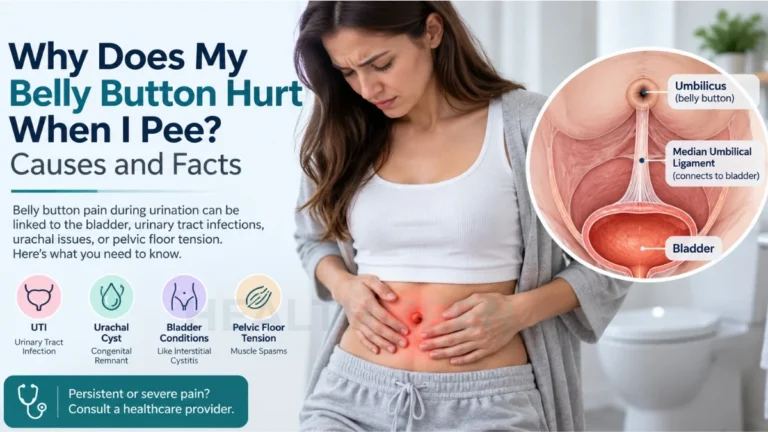
Noticing that the physical opening of your belly button is suddenly shrinking, narrowing, or appearing to completely close up is a highly unusual visual symptom. Because the umbilicus is the most prominent topographical feature on the human abdomen, any rapid change in its shape or depth immediately causes concern. However, to understand why a navel is closing, you must recognize that the human belly button is not a functional biological orifice like the mouth or the nostrils. It is entirely composed of dense, fibrous scar tissue permanently anchored to the underlying abdominal muscles.
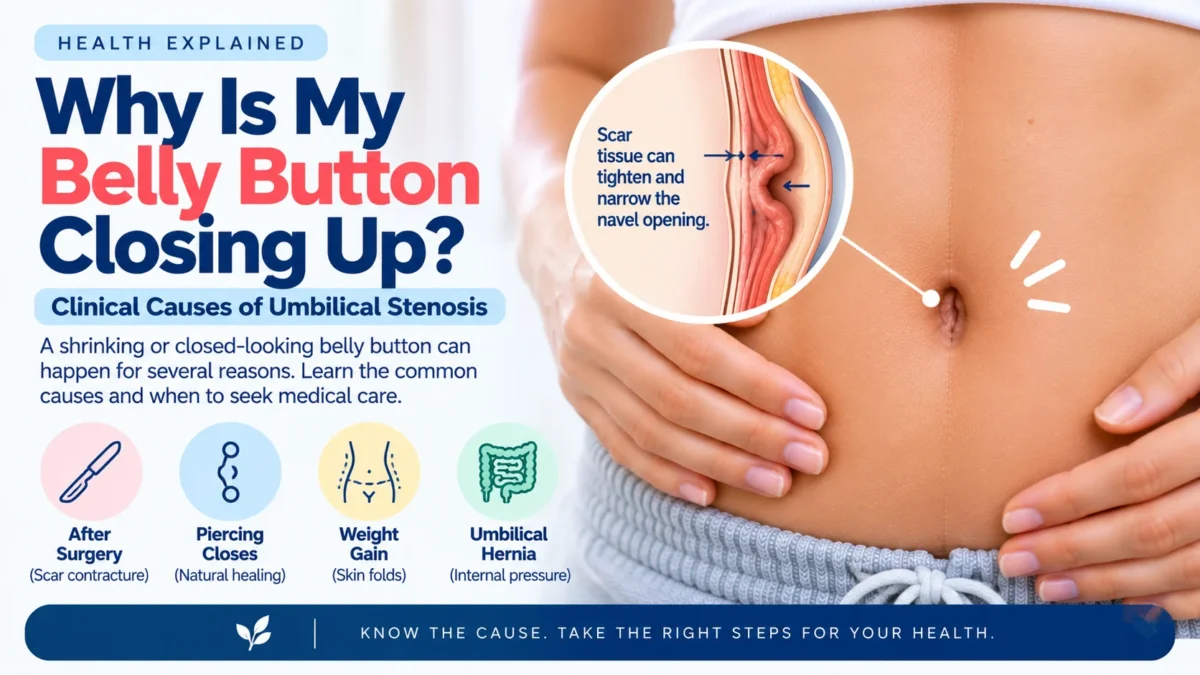
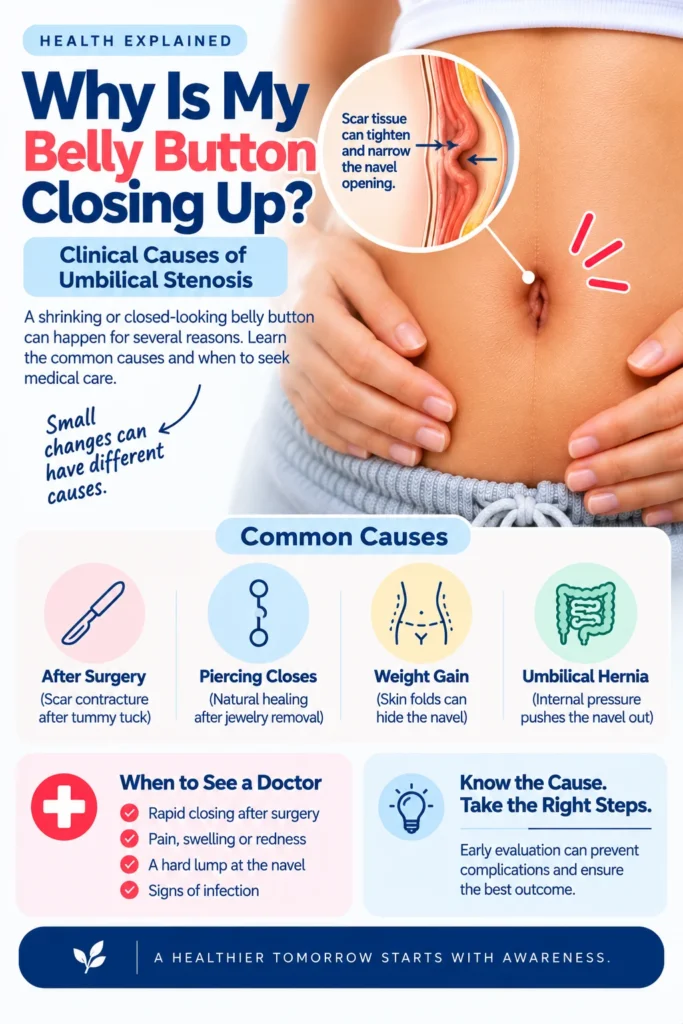
Because it is simply a structural scar, a belly button does not possess muscles to open or close itself. When a navel appears to be closing up, it is reacting entirely to intense mechanical forces pulling or pushing against the surrounding tissue. In clinical dermatology and plastic surgery, a closing belly button is typically the direct result of postoperative scar contracture following a cosmetic procedure, the rapid biological epithelialization of an abandoned piercing tract, severe localized weight gain, or the internal outward pressure of a growing umbilical hernia. By analyzing your recent medical history and the physical mechanics of your abdominal wall, you can precisely identify the structural phenomenon responsible for shrinking your navel.
Postoperative Umbilical Stenosis After a Tummy Tuck
The most frequent and clinically documented cause of a belly button aggressively closing up is a postoperative complication known as umbilical stenosis. This strictly occurs in patients who have recently undergone an abdominoplasty, commonly known as a tummy tuck, or an umbilicoplasty, a surgical reshaping of the navel.
During a traditional tummy tuck, the plastic surgeon completely detaches the abdominal skin from the original belly button. The skin is pulled tightly downward to flatten the stomach, and a brand new hole is carved into the tightened skin to pull the original belly button back through to the surface. As this newly carved circular wound begins to heal, the body deploys specialized cells called fibroblasts to create fresh collagen.
In a biological process known as concentric scar contracture, this newly formed ring of scar tissue begins to aggressively shrink and tighten as it matures. Because the incision is a complete circle, the scar tissue pulls inward from all three hundred and sixty degrees simultaneously. If the contracture is severe, it acts like a tightening drawstring on a bag, physically strangling the opening of the newly created belly button until it shrinks into a tiny, narrow slit or closes entirely. This is why many plastic surgeons require their patients to wear medical-grade silicone belly button plugs or shapers for several months postoperatively to physically block the scar tissue from contracting and closing the hole.
Epithelialization and Piercing Tract Closure
If you have recently removed a piece of jewelry from a navel piercing and subsequently noticed the hole rapidly closing, you are witnessing the body’s highly efficient secondary intention wound healing process.
A belly button piercing is a man-made puncture wound that the body tolerates only because the physical presence of the metal jewelry blocks the tissue from fusing back together. The moment the jewelry is permanently removed, the biological barrier is gone. The raw tissue inside the piercing tract immediately begins to fill with soft, vascular granulation tissue. Simultaneously, the epidermal cells on the surface begin a process called epithelialization, where they rapidly multiply and crawl across the opening to seal the breach. Within a matter of days or weeks, depending on the age of the piercing, the entire tract will permanently fuse shut, leaving behind a small, dense knot of scar tissue where the hole used to be.
Structural Masking via Subcutaneous Fat
Sometimes, the actual fascial scar of the belly button is not shrinking at all, but it visually appears to be closing up due to the rapid accumulation of surrounding abdominal fat. This is clinically referred to as structural masking.
When a person experiences significant, rapid weight gain, the body heavily deposits subcutaneous fat directly beneath the skin of the anterior abdominal wall. As this fat layer thickens, it physically forces the skin surrounding the umbilicus to rise and puff outward. Because the dense base of the belly button remains tightly anchored to the underlying muscle, it cannot rise with the expanding skin. Consequently, the expanding skin folds essentially swallow the navel. The heavy tissue presses tightly together over the opening, creating a deep, dark, horizontal crease that makes the belly button look completely closed off, even though the internal scar remains structurally unchanged.
Umbilical Hernias: Pushing from the Inside
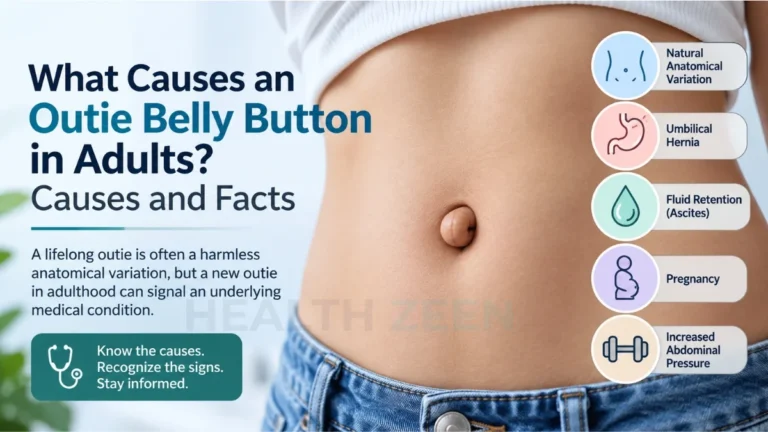
In distinct contrast to scar contracture pulling the hole shut, an umbilical hernia makes the belly button look closed by aggressively pushing it outward from the inside.
The umbilical ring is a natural structural weak point in your abdominal connective tissue. If extreme internal pressure from heavy lifting, chronic coughing, or pregnancy physically tears this fascial tissue, internal abdominal fat or intestines will squeeze through the defect. This creates a highly pressurized, physical bulge directly behind the navel.
As the hernia grows larger, it forcefully pushes the deeply recessed base of the belly button outward, entirely flattening the anatomical valley of the navel. Once the navel is pushed completely flush with the surrounding stomach skin, the traditional opening of the belly button physically disappears, replaced by a smooth, tight, and often tender bulge. In this scenario, the belly button has not healed shut; it has been mechanically inverted and erased by the internal herniation.
When to Seek Medical or Surgical Intervention
While a belly button slowly closing due to weight gain or an abandoned piercing is entirely harmless, other forms of closure require professional clinical intervention to prevent permanent aesthetic damage or life-threatening complications.
If your belly button is closing rapidly due to umbilical stenosis after an abdominoplasty, you must contact your plastic surgeon immediately. Once concentric scar contracture fully solidifies, the closure is permanent, and the only way to reopen the navel is through a secondary surgical revision to cut away the constricting scar tissue.
Furthermore, if your belly button appears closed because a hard, painful lump has pushed it outward, you must seek emergency medical evaluation. If this umbilical hernia becomes strangulated, meaning the blood supply to the trapped tissue is cut off, it transforms into a surgical emergency that requires immediate operative repair to prevent intestinal necrosis.
Frequently Asked Questions
Following a tummy tuck, the circular incision made to create your new belly button undergoes a healing process called concentric scar contracture. As the circular scar tissue heals and matures, it naturally tightens and pulls inward from all sides, which can physically shrink or completely close the navel opening.
No, a natural, unpierced, and surgically unaltered belly button cannot physically heal shut on its own. It is a fully matured, permanent scar. If a natural belly button appears to be closing, it is due to expanding skin folds from weight gain hiding the opening, or a hernia pushing it flat from the inside.
To prevent postoperative umbilical stenosis, plastic surgeons typically instruct patients to wear a specialized silicone belly button plug, a medical marble, or a customized earplug inside the navel for several weeks. This physical barrier forcibly stops the contracting scar tissue from shrinking the opening.
The speed of closure depends entirely on the age of the piercing. A fresh piercing less than six months old can begin to heal and close shut within twenty four to forty eight hours of removing the jewelry. A piercing you have had for a decade may take months to fully shrink, or it may never completely fuse shut.
A horizontal, slit-like belly button is most commonly caused by abdominal skin laxity or localized weight gain. As the stomach tissue loses elasticity or becomes heavy with subcutaneous fat, gravity pulls the upper skin fold downward, causing it to rest heavily over the lower skin fold and visually closing the navel.
Yes, a severe umbilical hernia can make the opening of your belly button completely disappear. The internal tissue pushes aggressively through the torn abdominal fascia, forcefully stretching the deeply recessed skin of the navel outward until it is entirely flat and flush with your stomach.
If your navel fully closes due to severe scar contracture after a tummy tuck, the area will look like a flat, solid sheet of scarred skin. The only way to restore the aesthetic appearance of the navel is to undergo a minor surgical revision where the surgeon physically cuts away the stricture and reconstructs the opening.
If your belly button appears closed strictly because deep skin folds and subcutaneous fat are pressing together over the opening, losing a significant amount of weight will reduce the volume of the surrounding tissue, allowing the natural depth and opening of the navel to become visible again.
Yes, it is highly dangerous. If you remove jewelry from an actively infected piercing, the surface skin will rapidly heal and close over the tract. This traps the aggressively multiplying bacteria deep under the skin, which inevitably leads to the formation of a severe, highly painful, and pressurized abscess.
Hard, tight skin inside the navel is the physical hallmark of dense, cross-linked collagen fibers forming scar tissue. This is a standard biological reaction following any abdominal surgery, laparoscopy port insertion, or severe localized skin infection as the body attempts to fortify the damaged tissue.
Conclusion
A belly button that is actively closing up is a fascinating demonstration of the mechanical and biological forces that constantly govern the human skin barrier. Because the umbilicus is inherently a passive structural feature, it can only respond to the environment surrounding it. Whether the closure is driven by the relentless, tightening grip of concentric scar contracture following a cosmetic abdominoplasty, the rapid epithelialization of an abandoned metal piercing tract, or the silent, outward pressure of an untreated fascial hernia, identifying the exact mechanical trigger is essential. By understanding the distinct physiological difference between tissue that is genuinely fusing together and tissue that is simply being masked by structural abdominal changes, you can implement the correct physical interventions such as utilizing medical silicone plugs, managing internal fascial pressure, or seeking a minor surgical revision to preserve and protect the unique anatomy of your navel.
Disclaimer
This blog is for informational and educational purposes only, and does not intend to substitute any professional medical advice or consultation. For any health related concerns, please consult with your physician, or call 911.