Why Does My Belly Button Hurt When I Pee? Causes and Facts
Belly button pain when you pee is primarily caused by an infected adult urachal cyst, interstitial cystitis, or referred nerve pain from a severe urinary tract infection. You must seek immediate medical evaluation if the localized navel pain is accompanied by cloudy urine, visible blood, or a sudden high fever, as these indicate a severe bacterial infection requiring prescription antibiotics.
Experiencing a sharp, pulling sensation directly behind your belly button while urinating is a highly specific clinical symptom that links your urinary tract to your anterior abdominal wall. Many adults assume the bladder is completely isolated deep within the lower pelvis. However, distinct anatomical structures directly tether the dome of the human bladder to the back of the umbilicus. When your bladder physically contracts to expel urine, any structural abnormalities or severe inflammation within these connective tissues will trigger sharp, localized pain radiating directly into the navel. Understanding this anatomical relationship is crucial for differentiating between a standard bladder infection and a structural fascial anomaly.
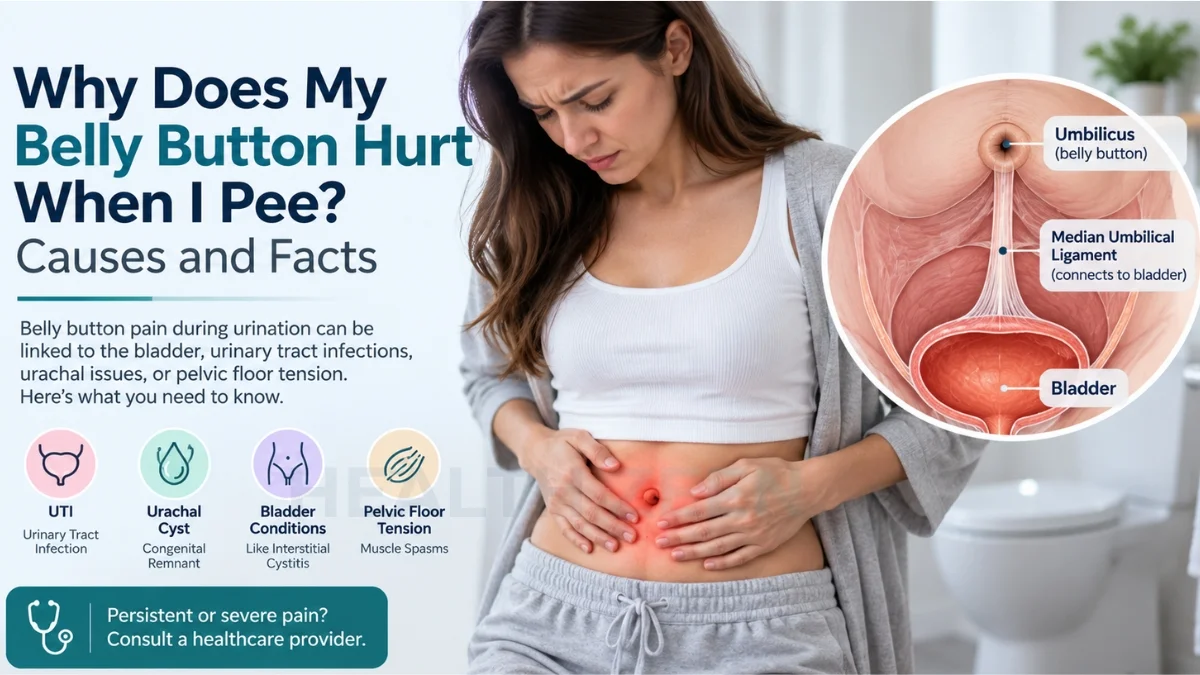
To understand why urination causes belly button pain, you must understand the function of the median umbilical ligament. Before you were born, a small tube called the urachus connected your developing bladder directly to your umbilical cord to remove liquid waste.
In a healthy adult, this tube completely collapses and solidifies into a thick, fibrous band of scar tissue known as the median umbilical ligament. This ligament runs straight down the inside of the abdominal wall, permanently anchoring the top of the bladder to the back of the belly button. When you urinate, your bladder muscles vigorously contract and shrink. This physical shrinking violently tugs on the median umbilical ligament. If this ligament is inflamed or structurally compromised, the physical pulling motion sends sharp pain signals straight up into the navel cavity.
Painful urination, clinically known as dysuria, typically causes a burning sensation in the lower urethra. When the pain specifically radiates to the belly button, it strongly indicates adult urachal anomalies, chronic bladder syndromes, or severe bacterial ascending infections.
Infected Adult Urachal Cysts
An adult urachal cyst is the most common structural cause of belly button pain during micturition. Sometimes, the fetal urachus fails to solidify completely, leaving a small, hollow cavity along the ligament. In adulthood, this hidden cavity can suddenly fill with fluid and become severely infected with opportunistic bacteria. According to the StatPearls Clinical Database (NCBI), an infected urachal cyst causes intense lower abdominal pain that drastically spikes when the bladder contracts during urination. If the cyst ruptures, it frequently leaks foul-smelling, purulent discharge directly out of the belly button.
Urinary Tract Infections (UTIs)
A severe urinary tract infection frequently causes referred pain that manifests at the umbilicus. When pathogenic bacteria aggressively colonize the bladder lining, they trigger massive internal inflammation. The parietal peritoneum lining the abdomen and the skin around the belly button share sensory pathways through the T10 spinal dermatome. The central nervous system frequently misinterprets the severe inflammatory distress signals originating from the infected bladder as sharp, localized pain occurring directly at the belly button.
Interstitial Cystitis (Painful Bladder Syndrome)
Interstitial cystitis is a chronic autoimmune and inflammatory condition that causes severe bladder pressure and pelvic pain without the presence of an active bacterial infection. The National Institute of Diabetes and Digestive and Kidney Diseases (NIDDK) notes that as the bladder fills with urine, the compromised bladder walls stretch painfully. The moment the patient begins to urinate and the inflamed bladder rapidly decompresses, it generates a sharp, agonizing muscle spasm that radiates up the median umbilical ligament, resulting in severe belly button pain.
Pelvic Floor Muscle Spasms
The bladder is heavily supported by a complex network of pelvic floor muscles and dense abdominal fascia. Adults suffering from chronic pelvic floor dysfunction frequently experience severe muscle spasms when they attempt to empty their bladder. These intense spasms physically yank on the lower abdominal connective tissue, creating a sharp pulling sensation that travels upward along the linea alba and terminates directly behind the belly button.
Medical professionals utilize a combination of clinical laboratory testing and advanced pelvic imaging to pinpoint the exact structural or infectious cause of urination-related navel pain.
Physicians begin with a comprehensive urinalysis and urine culture to detect the presence of white blood cells, nitrites, and specific bacterial strains indicating a severe urinary tract infection. If the urine culture is completely sterile but the patient still experiences severe pain upon bladder contraction, the doctor will order a high-resolution abdominal ultrasound or a pelvic CT scan. These advanced imaging techniques allow the physician to visually inspect the median umbilical ligament and identify hidden adult urachal cysts or abnormal fascial tethering connecting the bladder to the umbilicus.
What Are the Medical Treatments?
Treatment protocols for umbilical pain during urination focus entirely on eradicating bacterial colonizations and repairing structural fascial defects.
For a confirmed bacterial urinary tract infection, doctors prescribe targeted oral antibiotics, such as nitrofurantoin or ciprofloxacin, to rapidly destroy the localized pathogens. If advanced imaging confirms the presence of an infected adult urachal cyst, treatment requires immediate intravenous antibiotics followed by a minor laparoscopic surgery. General surgeons will completely excise the infected urachal remnant and detach the median umbilical ligament from the navel to permanently prevent recurrent infections and stop the mechanical pulling sensation during urination.
When Should You Consult a Doctor?
You must consult a healthcare provider immediately if the pain in your belly button while peeing persists for more than 48 hours or becomes progressively sharper with each bathroom visit.
Seek immediate emergency medical care if the navel pain is accompanied by visibly red or dark brown urine (hematuria), indicating severe internal bleeding within the urinary tract. Furthermore, if you develop a sudden high fever, uncontrollable shivering, severe nausea, or sharp pain radiating into your mid-back, you must proceed to an emergency department without delay. These critical clinical markers strongly indicate that a localized bladder infection has actively ascended into your kidneys, risking life-threatening systemic sepsis.
Your belly button pulls when you pee because the top of your bladder is physically tethered to the back of your navel via the median umbilical ligament. As the bladder shrinks during urination, it mechanically yanks this fibrous cord downward.
Yes, a severe urinary tract infection can cause pain in the belly button. The intense inflammation inside the infected bladder triggers referred pain that travels up the shared T10 spinal nerve pathway, causing localized discomfort at the umbilicus.
What is a urachal cyst in adults?
A urachal cyst in adults is a small, fluid-filled sac located on the ligament connecting the bladder to the belly button. It is a leftover remnant from fetal development that can suddenly become infected in adulthood, causing severe pain during urination.
No, it is not physiologically normal to feel direct pressure in the belly button when your bladder is full. This specific sensation indicates abnormal tension along the median umbilical ligament or an undiagnosed fascial defect in the lower abdominal wall.
Can interstitial cystitis cause umbilical pain?
Yes, interstitial cystitis frequently causes umbilical pain. The chronic inflammation makes the bladder walls exquisitely sensitive. The rapid decompression of the bladder during urination causes severe muscle spasms that radiate upward toward the belly button.
If your belly button leaks fluid when you pee, you likely have a rare structural defect called a patent urachus. This means the fetal tube connecting your bladder to your navel never closed, allowing urine to literally leak out of your umbilicus.
While passing a kidney stone primarily causes excruciating pain in the flank and lower back, the pain frequently radiates across the entire lower abdomen and groin. This widespread nerve irritation can occasionally manifest as sharp, stabbing pain near the navel.
Yes, severe pelvic floor dysfunction causes extreme muscle spasms during urination. These forceful spasms physically pull on the interconnected abdominal fascia, creating a distinct, sharp tearing sensation directly behind the belly button.
If it hurts to press your belly button after peeing, it strongly indicates severe localized inflammation of the underlying parietal peritoneum or an actively infected urachal cyst situated directly beneath the epidermal tissue.
Yes, increasing your water intake helps flush potential bacteria out of your urinary tract and dilutes highly acidic urine, which can temporarily reduce bladder irritation. However, you must still seek clinical evaluation to rule out structural cysts.
Conclusion
Experiencing sharp belly button pain when you pee serves as a critical diagnostic marker connecting your urinary tract directly to your anterior abdominal wall. Unlike standard urethral burning associated with minor infections, navel pain during micturition points specifically toward mechanical tension along the median umbilical ligament, an infected adult urachal cyst, or the severe referred pain of interstitial cystitis. Because the bladder physically shrinks and pulls on the internal fascial cords during urination, any inflammation along this pathway generates intense, localized discomfort. If your umbilical pain is accompanied by cloudy urine, visible blood, or a sudden high fever, you must seek immediate professional medical evaluation to receive targeted antibiotics and rule out severe structural anomalies requiring surgical excision.
Disclaimer
This blog is for informational & educational purposes only, and does not intend to substitute any professional medical advice or consultation. For any health related concerns, please consult with your physician, or call 911.