What Causes a Belly Button Hernia? Clinical Anatomy and Risk Factors
Developing a sudden bulge directly inside or immediately next to your navel can be a highly alarming experience. While many people associate hernias with heavy lifting or sports injuries, a belly button hernia, clinically known as an umbilical hernia, is fundamentally an issue of structural weakness in your abdominal connective tissue. To understand exactly what causes this condition, you must look beyond the surface scar of the umbilicus and examine the mechanical forces operating constantly within your abdominal cavity.
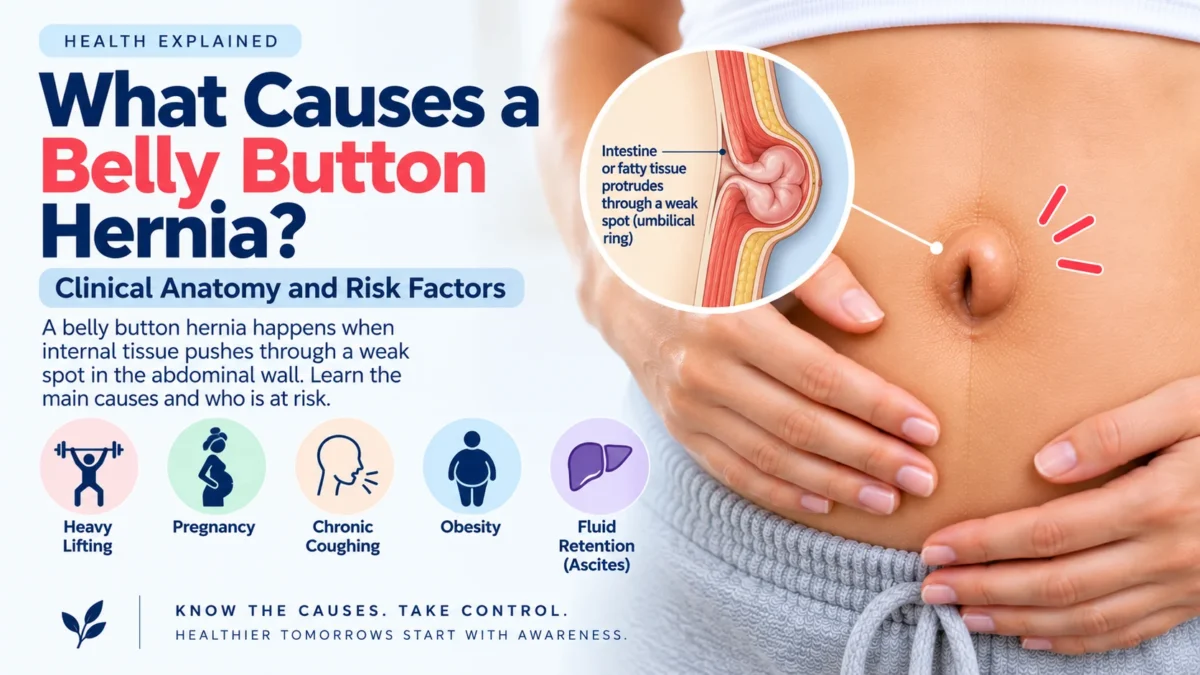
An umbilical hernia occurs when the tough, fibrous tissue holding your abdominal wall together develops a microscopic tear or stretches beyond its elastic limit. Once this structural breach occurs, the immense physical pressure generated by your internal organs forces underlying fatty tissue or sections of your intestines through the hole, creating a visible, tender lump. By exploring the complex anatomy of the umbilical ring, understanding the biomechanics of intra-abdominal pressure, and recognizing the critical difference between a harmless protrusion and a strangulated bowel, you can accurately identify the clinical triggers responsible for your umbilical hernia.
The Anatomy of the Umbilical Ring and Linea Alba
The primary root cause of all belly button hernias is a structural vulnerability located precisely at the center of your abdomen, known as the umbilical ring.
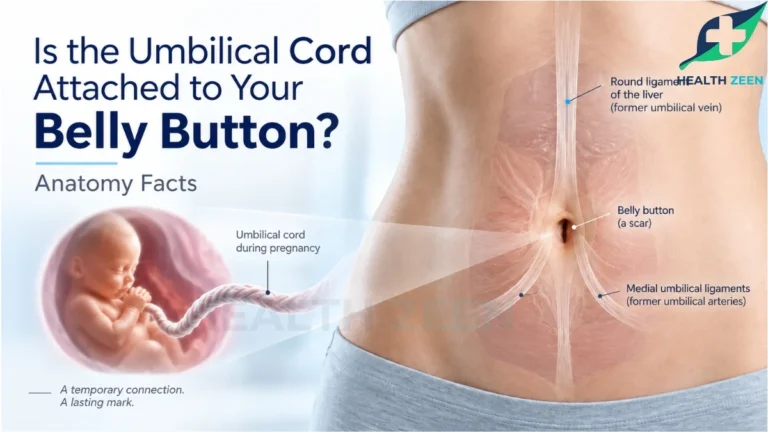
Your anterior abdominal wall is held together by a thick, highly resilient band of vertical connective tissue called the linea alba. This band runs straight down the middle of your stomach, separating your left and right abdominal muscles. Directly in the center of the linea alba sits the umbilical ring. Before you were born, this ring was a natural opening that allowed the umbilical cord to pass blood and nutrients from your mother directly into your developing body.
Within the first few weeks after birth, the umbilical ring is supposed to close completely, fusing into a solid, impenetrable wall of dense fascial scar tissue. However, this specific intersection remains the absolute weakest point in the entire human abdominal wall. For the rest of your life, the tissue behind your navel is thinner and far more fragile than the surrounding abdominal muscles. A belly button hernia is caused when this naturally vulnerable ring fails to withstand the mechanical forces pushing against it from the inside.
Elevated Intra-Abdominal Pressure
If the umbilical ring is the structural weak point, elevated intra-abdominal pressure is the physical trigger that actually causes the hernia to form in adults. Your abdominal cavity functions like a highly pressurized, sealed balloon. Whenever you engage your core muscles, the pressure inside this cavity spikes dramatically. If this pressure becomes too extreme or is sustained for prolonged periods, the force acts like a wedge, physically tearing open the weak fascial tissue behind the belly button.
Chronic Heavy Lifting and Physical Straining
The most common mechanical cause of an umbilical hernia is chronic, repetitive physical straining. Weightlifters, construction workers, and individuals whose occupations require them to lift heavy objects constantly subject their linea alba to massive spikes in intra-abdominal pressure. When you hold your breath and brace your core to lift a heavy weight, you generate immense outward force against your abdominal wall. Over years of repetitive strain, this sheer force gradually stretches the umbilical ring until the fascial fibers finally snap, allowing internal tissue to protrude.
Multiple Pregnancies and Diastasis Recti
Pregnancy places extraordinary mechanical stress on the entire abdominal structure. As the uterus expands rapidly over nine months, it drastically stretches the linea alba outward and sideways. In many women, especially those carrying multiple pregnancies or twins, this extreme stretching causes a condition called diastasis recti, where the left and right abdominal muscles permanently separate. This severe separation leaves the central umbilical ring entirely unsupported. Without the stabilizing force of tight abdominal muscles, the stretched, thinned-out fascia around the navel easily tears, causing a postpartum umbilical hernia.
Severe Chronic Coughing and Respiratory Conditions
Adults suffering from severe, untreated respiratory conditions, such as chronic obstructive pulmonary disease or chronic bronchitis, are at a surprisingly high risk of developing belly button hernias. The biomechanics of a violent, hacking cough require the abdominal muscles to violently and rapidly contract to force air out of the lungs. If a patient experiences severe coughing fits for weeks or months, these thousands of violent micro-contractions systematically hammer against the umbilical ring, eventually weakening the fascia enough to cause a structural failure.
Ascites and Severe Fluid Retention
In patients with chronic liver disease, such as cirrhosis, the portal vein becomes severely restricted. This leads to a dangerous clinical condition known as ascites, where massive amounts of serous fluid permanently accumulate directly inside the peritoneal cavity of the abdomen. Unlike the temporary pressure of a cough or a heavy lift, ascites places severe, relentless, twenty-four-hour hydrostatic pressure against the back of the belly button. The sheer volume of trapped fluid slowly expands the abdominal cavity from the inside out, silently stretching the umbilical ring until a hernia inevitably erupts.
The Pathogenesis of Herniation: What Actually Pokes Through?
When the fascial tear finally occurs, the empty space is rapidly filled by whatever internal abdominal structures are resting closest to the belly button.
In the vast majority of early adult umbilical hernias, the substance that pushes through the tear is not your intestine, but rather a structure called the omentum. The omentum is a thick, highly vascularized apron of visceral fat that hangs down over your intestines to protect them. Because the omentum rests directly against the anterior abdominal wall, it is usually the first tissue to be squeezed through the umbilical defect. An omental hernia feels soft, slightly squishy, and can typically be easily pushed back inside the abdomen when you lie down flat.
However, if the fascial tear expands due to continued physical straining, a loop of your small intestine can become trapped in the defect. This is a much more serious clinical scenario. An intestinal hernia will feel incredibly firm, highly sensitive to the touch, and may cause localized cramping as digestive fluids struggle to pass through the pinched section of the bowel.
Recognizing Incarceration and Strangulation
Understanding what causes a hernia is vital, but understanding how a benign hernia transforms into a life-threatening surgical emergency is critical.
If the protruding omentum or loop of intestine becomes tightly wedged within the narrow fascial tear and can no longer be massaged back into the abdomen, the hernia is clinically classified as incarcerated. An incarcerated hernia causes chronic, sharp pain and creates a permanent, hard bulge at the navel.
If an incarcerated hernia is left completely untreated, the edges of the torn fascia can act like a tight rubber band, completely cutting off the arterial blood supply to the trapped tissue. This catastrophic progression is known as a strangulated hernia. When the tissue is starved of oxygen, it undergoes rapid necrosis, meaning the trapped intestine physically dies within a matter of hours. A strangulated umbilical hernia will turn a dark purple or black color, become agonizingly painful, and trigger severe systemic symptoms like projectile vomiting, an inability to pass gas, and a high fever.
Frequently Asked Questions
A belly button hernia is caused by a physical tear or structural weakness in the umbilical ring, which is the fascial connective tissue behind your navel. When extreme intra-abdominal pressure builds up from lifting, coughing, or pregnancy, it forces internal fat or intestines through this weak point.
Can lifting heavy weights cause an umbilical hernia?
Yes, heavy lifting is a leading mechanical cause of umbilical hernias in adults. Holding your breath and bracing your core to lift massive amounts of weight causes your internal abdominal pressure to spike violently, which can physically rip the connective tissue surrounding your belly button.
During pregnancy, the rapid expansion of the uterus severely stretches the linea alba, the connective tissue running down the center of the stomach. This extreme stretching severely weakens the umbilical ring, leaving it highly vulnerable to tearing and herniation during labor or in the postpartum period.
Can chronic coughing cause a hernia in my stomach?
Yes, chronic and violent coughing fits, often associated with prolonged respiratory illnesses, force your abdominal muscles to violently spasm. Over time, these relentless, high-pressure internal strikes continuously pound against the weak umbilical fascia until a tear is formed.
In most mild to moderate cases, an umbilical hernia is filled with a specialized visceral abdominal fat called the omentum. In more severe or advanced cases where the fascial tear is large, a highly sensitive loop of the small intestine can push through the opening.
How do I know if my hernia is strangulated?
A strangulated hernia is a medical emergency. You will know it is strangulated if the bulge suddenly becomes excruciatingly painful, turns dark red, purple, or black, feels rock hard to the touch, and is accompanied by a high fever, severe nausea, and sudden projectile vomiting.
No, an adult belly button hernia will never heal on its own. Because a hernia is a physical, structural tear in dense connective tissue that lacks a heavy blood supply, it cannot sew itself back together. It will only slowly grow larger over time unless a surgeon permanently repairs the defect with sutures or surgical mesh.
Does being overweight cause umbilical hernias?
Yes, severe obesity places constant, relentless mechanical stress on the anterior abdominal wall. The massive volume of internal visceral fat permanently elevates resting intra-abdominal pressure, constantly pushing outward against the umbilical ring until the weakened fascia finally gives way.
If your hernia is soft, entirely painless, and easily slips back into your abdomen when you lie flat on your back, it is generally safe to gently reduce it. However, if the hernia is hard, tender, or requires significant force to move, you must never push it, as you could easily rupture a trapped intestine.
When you stand completely upright, gravity aggressively pulls your internal organs downward and outward against your anterior abdominal wall. This naturally forces more omental fat or intestinal tissue directly into the fascial tear, causing a sharp stretching sensation and localized nerve pain at the navel.
Conclusion
Ultimately, a belly button hernia is a mechanical failure of the human body’s intricate connective tissue network. The umbilical ring remains a permanent structural vulnerability, a fragile remnant of fetal development that must constantly withstand the immense, invisible forces generated within your abdominal cavity. Whether triggered by the sudden, violent pressure of a heavy deadlift, the gradual, unrelenting stretching of a twin pregnancy, or the chronic hydrostatic fluid buildup associated with severe liver disease, the underlying mechanism is always the same. The tough fascial wall reaches its physical breaking point, tearing open and allowing the pressurized internal environment to spill outward. Because torn abdominal fascia is biologically incapable of regenerating or healing itself, ignoring the bulge will only allow the daily pressures of standing, coughing, and lifting to slowly widen the defect. By understanding the precise mechanical causes that created the tear in the first place, you can protect the area from further strain, seek a definitive surgical repair, and permanently eliminate the terrifying risk of a strangulated bowel.
Disclaimer
This blog is for informational and educational purposes only, and does not intend to substitute any professional medical advice or consultation. For any health related concerns, please consult with your physician, or call 911.