
Will a Belly Button Infection Go Away on Its Own? Healing Facts
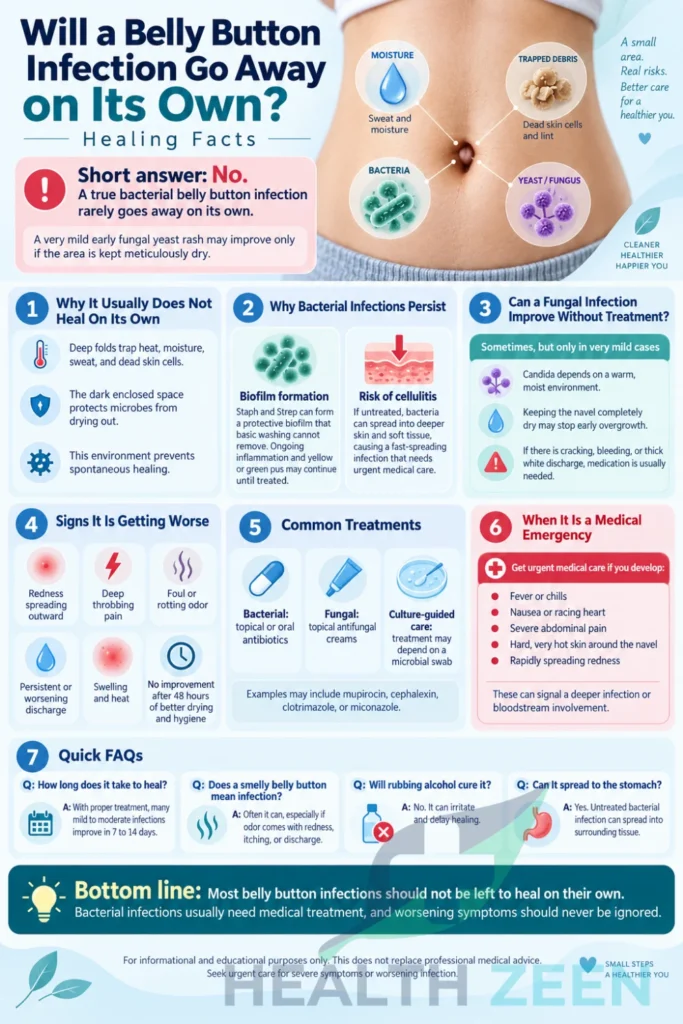
No, a true bacterial belly button infection will rarely go away on its own. Because the deep anatomical folds of the adult umbilicus constantly trap heat, moisture, and dead skin cells, the environment actively prevents spontaneous clinical resolution. While a very mild superficial fungal yeast overgrowth might resolve if you drastically alter the localized environment by keeping it completely dry, any infection producing foul-smelling pus requires professional clinical intervention and prescription medications to heal.
Many adults assume that minor skin infections will naturally heal over time as the human immune system fights off the invading pathogens. While this is true for a scrape on your arm, the belly button presents a unique biomechanical challenge. The inward-folding structure of an innie navel creates a permanent dark, damp pocket that completely shields dangerous bacteria and fungi from exposure to dry air. Understanding the exact nature of the invading pathogen is critical to determining whether your localized inflammation will eventually subside with basic hygiene or rapidly progress into a dangerous, deep-tissue abdominal infection.
Why Bacterial Infections Do Not Heal Spontaneously
If your belly button is infected with aggressive strains of Staphylococcus or Streptococcus bacteria, clinical omphalitis has occurred. This specific type of bacterial infection will almost never resolve without medical intervention.
The Danger of Bacterial Biofilms
When bacteria colonize the deep folds of the belly button, they rapidly consume trapped keratin, oxidized dead skin cells, and daily sweat. To protect themselves from your body’s natural immune response, these bacterial colonies secrete a thick, slimy protective shield known as a biofilm. Once a biofilm is established inside the navel cavity, basic soap and water cannot penetrate it. The bacteria will continuously multiply behind this shield, triggering chronic inflammation and the continuous leaking of thick, green, or yellow purulent discharge. Without targeted topical or oral antibiotics to physically destroy the cellular walls of the bacteria, the infection will remain active indefinitely.
Progression to Cellulitis
Because the skin inside the belly button is the thinnest section of the anterior abdominal wall, leaving a bacterial infection untreated poses a severe medical risk. If the bacteria are not eradicated through medical intervention, they will eventually eat through the degraded epidermal barrier and invade the deep subcutaneous tissue of your stomach. This triggers a severe, rapid-spreading infection called cellulitis, which requires emergency hospitalization and intravenous antibiotics to prevent the pathogens from entering your bloodstream and causing fatal sepsis.
Can a Fungal Yeast Infection Resolve Without Treatment?
Unlike aggressive bacterial pathogens, a fungal yeast infection (caused by Candida albicans) relies entirely on its surrounding environment to survive. In very mild, early-stage cases, it is occasionally possible for a fungal overgrowth to achieve spontaneous clinical resolution if you immediately remove its life-support system.
Candida yeast requires a warm, exceptionally moist environment to replicate. If you suddenly change the localized environment of your belly button by meticulously drying the cavity with a clean paper towel after every shower and avoiding tight, non-breathable clothing, you physically dehydrate the fungus. In minor cases of localized erythema, this strict environmental modification can halt the fungal multiplication, allowing your skin barrier to slowly heal on its own over a few weeks. However, if the yeast infection has already caused the skin to crack, bleed, or produce a thick cottage-cheese-like discharge, environmental changes alone will no longer suffice, and you must apply a topical antifungal medication.
How to Tell if Your Infection Is Getting Worse
Monitoring the localized symptoms daily is crucial for determining if your wait-and-see approach is failing. You must evaluate the clinical markers of the infection to gauge the severity of the tissue damage.
If your belly button is attempting to heal on its own, the initial redness should begin to fade into a light pink, the sharp itching should subside, and any weeping fluid should completely dry up within forty-eight hours of improving your hygiene. Conversely, if the localized redness begins spreading outward across your abdomen in distinct streaks, the pain transitions from a mild itch to a deep throbbing ache, or the cavity begins emitting a rotting, foul odor, the infection is actively overcoming your immune system and requires immediate clinical diagnosis.
Medical Treatments Required for Healing
When an umbilical infection refuses to go away on its own, medical professionals utilize targeted therapies based directly on the results of a microbial swab culture.
For unyielding bacterial infections, physicians prescribe a localized topical antibiotic ointment, such as mupirocin, to directly penetrate the biofilm and eradicate the staphylococcus colonies. If the bacterial infection has breached the deeper dermal layers, a seven to ten-day course of oral antibiotics like cephalexin is mandatory. For stubborn fungal yeast infections that survive environmental drying, dermatologists prescribe over-the-counter or prescription-strength topical antifungal creams, such as clotrimazole or miconazole, to destroy the fungal cell membranes and rapidly stop the intense localized burning and itching.
When Is an Infection a Medical Emergency?
You must abandon all attempts at spontaneous healing and consult a healthcare provider immediately if the localized infection begins producing systemic symptoms.
Seek emergency medical care if the untreated belly button infection suddenly causes a high fever, severe uncontrollable shivering, nausea, or a racing heart rate. Furthermore, if you experience sharp, agonizing pain when you press on your stomach, or if the abdominal skin surrounding the navel becomes rigidly hard and extremely hot to the touch, you must proceed to an emergency department without delay. These critical markers indicate that the surface infection has breached the abdominal fascia and is actively threatening your internal organs or your systemic bloodstream.
Frequently Asked Questions About Infection Healing
No, a severe bacterial belly button infection will rarely go away on its own. The deep folds trap moisture and allow bacteria to form protective biofilms, meaning the infection requires clinical antibiotics to properly heal and prevent spreading.
With appropriate prescription antibiotic or antifungal treatment, a mild to moderate belly button infection typically takes between seven and fourteen days to heal completely. Without medical treatment, the infection can persist for months and progressively worsen.
You should not leave a yeast infection completely untreated. While very mild cases might subside if you keep the navel perfectly dry, untreated candidiasis frequently causes severe skin maceration, painful cracking, and invites secondary bacterial pathogens into the raw wounds.
Your belly button infection is not healing because the internal cavity is remaining damp throughout the day, allowing the pathogens to continuously multiply. Additionally, you may be using an antibacterial cream on a fungal infection, which provides absolutely no clinical benefit.
You cannot physically draw out an infection from a belly button using home remedies like poultices or suction. Attempting to do so severely damages the thin epidermal tissue. The only clinical way to eliminate the infection is through targeted antimicrobial medications.
Yes, an untreated bacterial belly button infection can easily spread into the deep subcutaneous fat of the stomach. This rapid spreading causes cellulitis, characterized by massive abdominal swelling, severe pain, and dangerous systemic inflammation requiring emergency intervention.
No, rubbing alcohol will not cure a belly button infection. Applying isopropyl alcohol to infected, inflamed skin causes excruciating chemical burning, violently strips away the remaining moisture barrier, and severely delays the natural cellular healing process.
A smelly belly button frequently indicates an active infection. When bacteria and fungal yeast rapidly digest trapped dead skin cells and sweat, they produce specific metabolic waste gases that generate a sharp, distinct, and highly foul odor.
An infected, deeply embedded navel stone (omphalith) will rarely come out on its own because it is tightly tethered to the inflamed surrounding tissue. It requires a doctor to safely soften the calcified mass and extract it using sterile clinical forceps.
You should only keep your infected belly button covered if it is actively leaking purulent discharge, to prevent staining your clothes. Otherwise, leaving it uncovered while at home allows crucial air circulation, which helps physically dry out the environment and suppress fungal growth.
Conclusion
Hoping a belly button infection will go away on its own is a medically risky strategy due to the unique anatomical structure of the adult umbilicus. While the human immune system is highly efficient, the dark, damp, and enclosed folds of an innie navel provide a perfect sanctuary for aggressive staphylococcus bacteria and Candida yeast to continuously multiply. Although maintaining a strictly dry environment can occasionally halt the progression of a very mild, early-stage fungal rash, deep-seated bacterial biofilms and purulent discharge demand immediate clinical intervention. You must carefully monitor the localized symptoms; if the redness begins spreading, the pain intensifies, or the odor worsens despite rigorous drying, you must seek professional medical evaluation to acquire the specific topical or oral medications required to eradicate the pathogens safely.
Disclaimer
This blog is for informational & educational purposes only, and does not intend to substitute any professional medical advice or consultation. For any health related concerns, please consult with your physician, or call 911.