Why Is My Belly Button Itchy? Causes, Rash, and Treatments
An itchy belly button is primarily caused by allergic contact dermatitis from a nickel belt buckle or jeans button, a fungal Candida yeast infection, or intertrigo (skin friction). To stop the severe itching, you must keep the navel cavity completely dry and apply an over-the-counter hydrocortisone cream for allergies, or a targeted antifungal cream for yeast overgrowths.
Experiencing severe itching inside or around your navel, clinically known as umbilical pruritus, is a highly irritating dermatological symptom that frequently disrupts daily life. The belly button acts as a deep structural fold on the human abdomen, making it a natural collection point for sweat, lint, and dead skin cells. While occasional mild itching is a normal reaction to clothing friction or dry skin, an intense, persistent itch accompanied by a red rash indicates an active localized immune response. You must identify the exact underlying allergen, pathogen, or skin condition driving the histamine release to stop the aggressive itching cycle and prevent secondary bacterial infections caused by constant scratching.
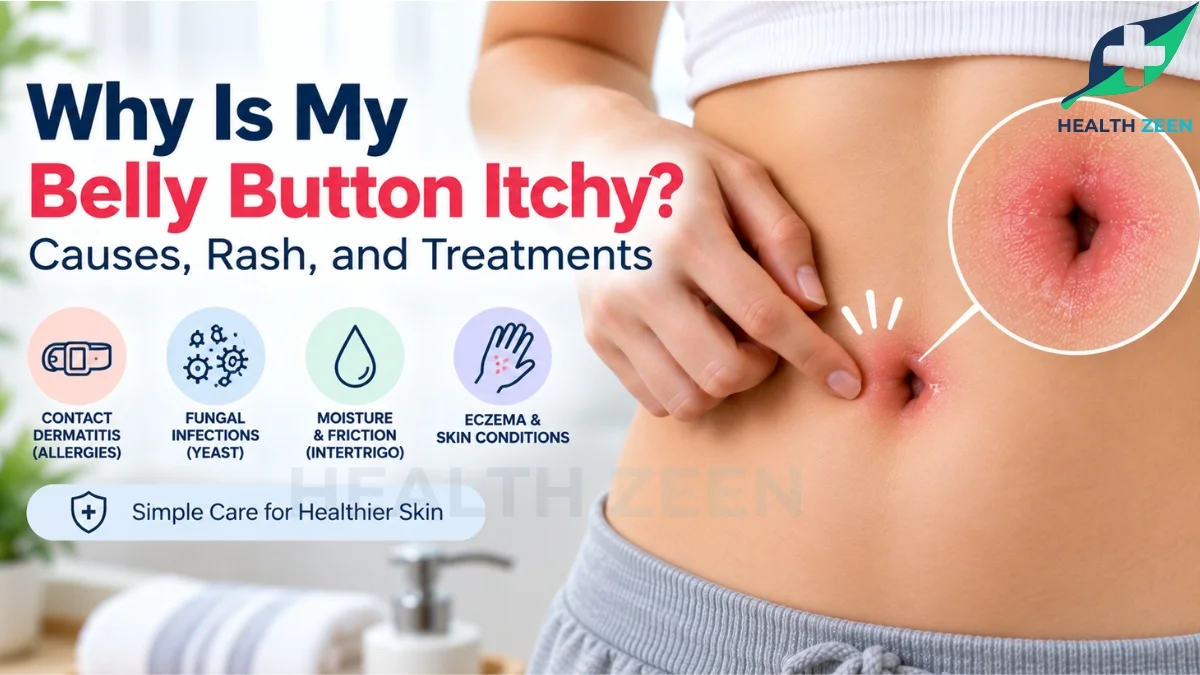
Allergic contact dermatitis, fungal yeast infections, intertrigo, and chronic skin conditions like eczema primarily cause an itchy belly button. These distinct medical conditions actively compromise the delicate epidermal barrier inside the naval cavity, triggering severe localized inflammation and intense pruritus.
Contact Dermatitis and Nickel Allergies
Allergic contact dermatitis is the leading cause of a highly itchy, red rash specifically located around the belly button. This condition occurs when your skin comes into direct physical contact with an external allergen. For the umbilicus, the most common culprit is a severe allergy to nickel found in metal belt buckles, jeans buttons, or low-quality navel piercings. According to the American Academy of Dermatology (AAD), when sensitive abdominal skin rubs against a nickel button, the immune system launches an aggressive allergic reaction, producing a raised, intensely itchy, and blistering rash exactly where the metal touched the skin.
Fungal Yeast Infections (Candidiasis)
The Candida yeast fungus requires warm, dark, and damp environments to rapidly multiply. An unwashed or poorly dried “innie” belly button provides the perfect anatomical habitat for this opportunistic pathogen. As the yeast overgrowth expands, it severely degrades the surface skin layers, causing an intense, burning itch. The Centers for Disease Control and Prevention (CDC) states that a cutaneous Candida infection presents with a bright red, extremely itchy rash accompanied by a thick, white, cottage-cheese-like discharge deep inside the navel folds.
Intertrigo (Skin-to-Skin Friction)
Intertrigo is an inflammatory skin condition that develops exclusively in deep skin folds due to severe skin-to-skin friction, trapped heat, and trapped moisture. Adults with increased abdominal adipose tissue frequently develop overlapping skin folds around the umbilicus. The constant rubbing physically destroys the protective stratum corneum layer, leaving the raw navel tissue intensely itchy, bright red, and highly susceptible to secondary bacterial or fungal infiltration.
Eczema and Inverse Psoriasis
Chronic autoimmune skin conditions frequently manifest directly inside the belly button. Atopic dermatitis (eczema) causes extreme localized dryness, leading to chronic scaling and unbearable itching. Alternatively, inverse psoriasis targets deep body folds rather than producing the typical dry, scaly plaques seen on elbows. The National Institutes of Health (NIH) notes that inverse psoriasis in the umbilicus presents as a smooth, shiny, bright red patch of highly irritated skin that constantly itches and burns, especially when you sweat.
An intensely itchy belly button is a highly common symptom following laparoscopic abdominal surgeries, such as gallbladder removal or hernia repair. Surgeons frequently utilize the umbilicus as the primary entry point for medical cameras.
As this surgical incision begins to heal, the regenerating nerve endings become highly sensitive and misfire, sending intense itch signals to the brain. Furthermore, many patients develop severe allergic reactions to the surgical glue, steri-strips, or adhesive bandages applied directly over the navel. This post-surgical contact dermatitis causes the surrounding abdominal skin to become bright red, slightly swollen, and incredibly itchy as the wound attempts to close.
How Do Doctors Diagnose Umbilical Pruritus?
Medical professionals diagnose the exact cause of an itchy belly button through direct visual inspection of the rash characteristics, detailed patient history, and targeted microbial cultures.
- Dermatological Assessment: The physician visually inspects the rash to determine if it aligns with the distinct shape of a belt buckle (indicating nickel allergy) or if it presents as a smooth, shiny red patch indicative of inverse psoriasis.
- Swab Culture: If the itching is accompanied by fluid or discharge, the doctor utilizes a sterile cotton swab to collect a sample. Laboratory analysis confirms whether the intense itching is driven by a bacterial pathogen or a Candida fungal overgrowth.
- Patch Testing: If contact dermatitis is suspected but the allergen is unknown, a dermatologist will perform localized patch testing on your back to formally identify specific chemical or metallic allergies driving the umbilical itch.
A physician prescribes specific targeted medical therapies based entirely on the underlying cause of the histamine release and localized umbilical inflammation.
- Topical Corticosteroids: Doctors recommend applying over-the-counter 1% hydrocortisone cream for three to five days to rapidly suppress the localized immune response and eliminate the severe itching caused by allergic contact dermatitis or eczema.
- Antifungal Medications: Physicians prescribe topical clotrimazole or miconazole creams to eradicate the rapidly multiplying Candida yeast pathogens driving the fungal itch.
- Barrier Creams: For chronic intertrigo, dermatologists suggest applying a thin layer of zinc oxide barrier cream to drastically reduce skin-to-skin friction and protect the healing navel tissue from irritating sweat.
When Should You Consult a Doctor?
You must consult a healthcare provider or a board-certified dermatologist immediately if the itching inside your belly button persists for more than a week despite using standard over-the-counter hydrocortisone creams or practicing strict daily hygiene.
Seek immediate emergency medical care if the intense itching suddenly transitions into severe throbbing pain, or if you notice red streaks spreading outward from the navel across your stomach. If the itchy area begins leaking thick green pus or becomes accompanied by a high fever, you must proceed to a medical clinic without delay. These symptoms dictate that a minor itchy rash has escalated into a severe localized bacterial infection requiring prescription oral antibiotics.
Your belly button is itching on the inside primarily due to trapped moisture, sweat, and dead skin cells that have triggered a localized fungal yeast infection (candidiasis) or caused raw irritation from severe skin-to-skin friction.
Yes, a dirty belly button causes severe itching. When dead skin, soap scum, and clothing lint accumulate deep inside the navel, they rot and create a highly irritating, damp environment that actively fuels intensely itchy bacterial and fungal overgrowths.
The skin around your belly button itches when you wear jeans due to allergic contact dermatitis. The metal button on your denim jeans typically contains nickel. When this nickel rubs against your bare abdominal skin, it triggers a severe, localized allergic reaction.
You stop your belly button from itching immediately by washing the area gently with mild soap, drying it completely with a paper towel, and applying a thin layer of over-the-counter 1% hydrocortisone cream to suppress the localized allergic histamine response.
Yes, a yeast infection is one of the leading causes of an itchy belly button. The Candida fungus severely inflames the delicate epidermal barrier inside the naval cavity, causing a burning itch accompanied by a bright red rash and white discharge.
Yes, it is extremely bad to scratch an itchy belly button. The skin inside the umbilicus is incredibly thin. Aggressive scratching with fingernails easily lacerates this tissue, directly introducing dangerous staph bacteria into the open wound and causing severe secondary infections.
Your belly button piercing itches so much because the surrounding tissue is actively healing, or because you have developed a severe metal allergy to the cheap jewelry. An intensely itchy, weeping piercing strongly indicates a localized contact dermatitis reaction to nickel.
No, a gastrointestinal stomach bug does not cause an itchy belly button. Stomach bugs cause internal nausea, cramping, and diarrhea, whereas an itchy belly button strictly indicates an external dermatological condition, allergy, or localized skin infection.
Yes, atopic dermatitis (eczema) frequently causes severe belly button itching. Eczema severely compromises the skin's natural moisture barrier, leading to extreme localized dryness, intense scaling, and a chronic itch deep inside the umbilical folds.
No, you must never put rubbing alcohol on an itchy belly button. Isopropyl alcohol violently strips all remaining moisture from the irritated skin, causing severe burning, microscopic tissue cracking, and drastically worsening the underlying dermatological condition.
Conclusion
An itchy belly button is a highly irritating clinical symptom that originates primarily from allergic contact dermatitis, fungal yeast infections, and severe skin-to-skin friction. Unlike deep abdominal pain, umbilical pruritus points strictly toward localized dermatological inflammation and compromised skin barriers. You must carefully evaluate your clothing choices for potential nickel allergens and maintain strict drying protocols after showering to prevent yeast overgrowth within the deep naval folds. If the intense itching persists despite applying over-the-counter hydrocortisone creams, or begins weeping thick purulent fluid, you must seek immediate clinical evaluation from a dermatologist to receive targeted prescription treatments and prevent secondary bacterial infections.
Disclaimer
This blog is for informational & educational purposes only, and does not intend to substitute any professional medical advice or consultation. For any health related concerns, please consult with your physician, or call 911.